
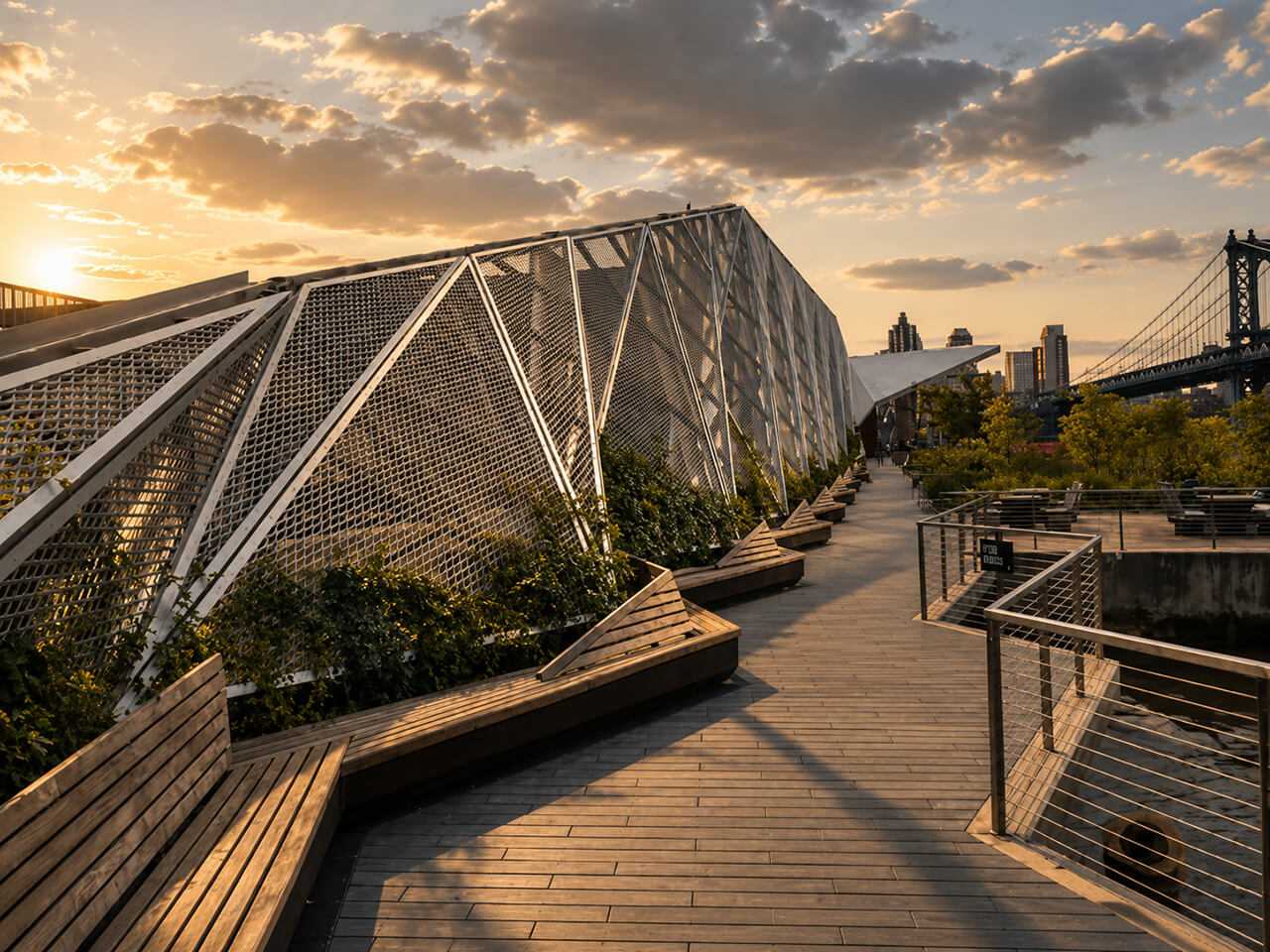
Most people think Manhattan ends where the asphalt meets the bike path, but there is a certain magic in rethinking that mindset. Those of us who have lived here long enough know the island actually begins about fifty feet further out. It starts at Pier 64, or Pier 42, or whatever forgotten wooden finger into the Hudson you’ve decided is yours.
To your left, the Midtown towers glow with a cold, blue light. Ahead, the Hudson is a sheet of moving silver, reflecting a sky that transitions from a bruised purple to a burning, cider orange. I have spent a decade wandering these edges, usually with a lukewarm coffee and no real destination.
Whether you are a local avoiding the crowds or a photographer chasing that liquid golden hour, these piers are more than maritime relics. They are the few places left where you can stand at the edge of the world and feel the horizon pull at you. This guide is for the explorers who know the true soul of New York is found where the city meets the water.
Best Piers in Manhattan for Skyline Photography and Quietude
While the world flocks to the Brooklyn Bridge for a standard postcard shot, the intentional local knows that the most evocative Manhattan skyline photography happens on the Hudson side. It is about the way the light catches the glass of Jersey City and reflects back onto the river in long, shimmering streaks: less “look at me,” more “look at this.”
Pier 64 (Chelsea)
At the end of West 24th Street, you will find Pier 64. It is not a place you stumble upon by accident. It features a massive, sloping green lawn that feels less like a pier and more like a floating meadow, managed by Hudson River Park as part of the borough’s longest continuous waterfront green space.
- Atmosphere: Quiet enough to hear the river slapping against the old wooden pilings. No heavy music, no sirens. Just the wind and the occasional kayaker heading south.
- The Shot: Premier spot for Manhattan skyline photography during blue hour. The lawn creates a lush, organic foreground against the industrial silhouette of the New Jersey skyline.
- Local Behavior: Residents with a single book and a blanket reclaim moments of silence here that the city rarely offers for free.
- Access: Open dawn to dusk, free admission. Dog-friendly on leash.
- Getting There: Take the C or E train to 23rd Street. Walk west on 23rd to the Hudson River Park path, then south to Pier 64. About 10 minutes on foot from the station.
Pier 45 (Christopher Street)
Known locally as the “Village Beach,” Pier 45 is a long, narrow finger that reaches deep into the Hudson. It is consistently rated among the best piers in Manhattan for sunset and golden hour photography. The Hudson River Park Trust renovated the boardwalk in recent years, and the improvements are invisible in the best way; the pier still feels earned.
- Atmosphere: In the late afternoon, the light turns a thick, syrupy gold: a 1970s film set: vibrant, a bit worn, deeply romantic without feeling staged.
- The Feature: The boardwalk stretches so far into the Hudson that city noise dissolves into a dull hum behind you, replaced by wind coming off the open water.
- Access: Open daily, free. Dog-friendly, well-lit at night. Benches along the full length.
- Getting There: Take the 1 train to Christopher Street–Sheridan Square. Walk west on Christopher Street to the water. The pier entrance is at the end of the block.
Best Piers in Manhattan for Local Vibes and Hidden Corners
The real New York is often found in the places that have not been completely sanitized for a brochure. These are the spots where you can still feel the city’s grit and grace simultaneously.
Pier 42 (Lower East Side)
While the rest of the waterfront gets polished, Pier 42 remains a deliberate secret. This expansive, eco-conscious space managed by NYC Parks, in partnership with local organizations, is the antithesis of a tourist trap.
- Atmosphere: Gritty but intentional. Community gardens and regulars who treat the river like their own backyard. Arguments over fishing lines are standard.
- The Hook: One of the few NYC waterfront spots where you can still see the industrial skeletal remains of the old maritime system, rusting beautifully alongside native plantings.
- Dog-Friendly: Yes. The open layout makes it one of the more comfortable off-leash-adjacent spots on the east side waterfront.
- Fishing Access: Yes. A small but loyal fishing community works this pier, primarily for striped bass and bluefish in season.
- Getting There: Take the F, M, J, or Z train to Delancey Street–Essex Street. Walk east on Delancey and south along the waterfront path. About 12 minutes from the station.
- Best Time to Visit: Tuesday morning. The silence, framed by the massive steel arc of the Williamsburg Bridge, is a local form of meditation.
Gansevoort Peninsula (Meatpacking District)
Manhattan’s newest beach is a marvel of urban planning that still feels like a neighborhood park. The Gansevoort Peninsula, technically a pier-turned-peninsula, offers a unique perspective on the West Village waterfront and opened fully to the public in 2024 after years of restoration.
- Atmosphere: Large stone boulders provide seating that feels permanent and ancient against the backdrop of the modern Whitney Museum across the West Side Highway.
- The Feature: Thomas Houseago’s public art installation “Day’s End” frames the open sky, making it a favorite among content creators seeking a genuinely new NYC angle.
- Local Insight: The salt marsh restoration is the real attraction for locals: a patch of functioning wetland in the middle of one of the world’s densest urban environments.
- Accessibility: Fully accessible. Paved paths to the water’s edge, accessible restrooms on site.
- Getting There: Take the A, C, or E train to 14th Street, or the L train to 8th Avenue. Walk west on Gansevoort Street to the waterfront. 8 minutes on foot.
Best Piers in Manhattan for Waterfront Proposals
If you are planning a moment that requires a cinematic backdrop without a crowded audience, leave the downtown grid and look for the peripheries. We have a full guide to the most dramatic proposal spots along the New York waterfront, but these two Manhattan piers deserve their own mention.
Dyckman Street Pier: Inwood
Surrounded by the high cliffs of the Palisades and the lush greenery of Fort Tryon Park, this pier feels more like a rugged coastal town than the northern tip of Manhattan.
- Atmosphere: The Hudson River here feels wild and uncontainable. The Palisades rise straight from the opposite bank, and the water moves with purpose.
- Romantic Edge: The most underrated waterfront proposal spot in Manhattan, especially when the sun dips behind the Jersey cliffs and turns the water a deep crimson.
- Local Tip: Grab a coffee in Inwood (try Inwood Local on Dyckman Street) and walk the path under the George Washington Bridge before the light fades. Hauntingly beautiful.
- Access: Open year-round, free. Limited lighting at night; best visited before sunset.
- Getting There: Take the 1 train to Dyckman Street–200th Street. Walk west on Dyckman Street to the river. 7 minutes on foot.
Pier 15: Financial District
For those who want a modern, tiered aesthetic, Pier 15 offers a double-decker experience with sweeping views of the East River. It sits within the South Street Seaport District, steps from the historic ships moored at Pier 17.
- Atmosphere: Glass railings and clean lines make the skyline feel like an extension of the park. Chic, but it can get windy.
- The View: Looking south, you have an unobstructed view of the Brooklyn Bridge and the historic ships docked at South Street Seaport.
- Why It Works for Proposals: The upper level often stays quieter than the ground floor, providing a semi-private stage. Arrive 45 minutes before sunset for the best light angle off the East River.
- Getting There: Take the 2 or 3 train to Fulton Street, or the 4 or 5 to Fulton Street. Walk east on Fulton to the waterfront. 6 minutes on foot.
For couples who want the skyline from the other side, looking back at Manhattan from the open water, a private harbor charter offers an entirely different kind of proposal setting. Big Apple Charters operates private yacht charters out of the Chelsea Piers area, with flexible itineraries that can include sunset passes under the Brooklyn Bridge or open-harbor cruises that frame the full Manhattan skyline. Worth considering if you want the water itself to be the venue, not just the backdrop.
How Locals Actually Discover NYC Waterfront Spots
Discovery in Manhattan is an exercise in ignoring the map and following your intuition. The best waterfront spots I have found came from two methods: following side streets until the pavement ended, and asking regulars at neighborhood bars where they go when they need to remember why they moved here.
The NYC Ferry is the most cinematic and underused discovery tool in the city. For $4, you get a harbor cruise that stops at landings most visitors never consider. Entire Saturdays spent hopping between Astoria, the Rockaways, and Red Hook feel like traveling without leaving the city.
For a different approach, our piece on Red Hook’s Industrial Soul and our commuters’ guide to the last ferry of the evening both document this kind of wandering in practice. The real waterfront is not on any top-ten list. It is in the in-between spaces, the small parks tucked between major piers, the ferry routes that work like a four-dollar harbor cruise.
Return to the same pier across seasons. The way winter light hits the steel peaks of Long Island City from Pier 42 is completely different from what we see in July. The city changes its costume; the water stays honest.
FAQ: Navigating the Manhattan Waterfront
Pier 64 in Chelsea for Hudson-side views during blue hour, and Pier 15 in the Financial District for East River and bridge perspectives. Both offer something the postcard version of New York does not: room to breathe.
Yes. The rooftop park at Pier 57 remains one of the best group-outing destinations on the Manhattan waterfront, particularly because it features a food hall at street level. Good for a date night that starts with food and ends with a skyline.
The Hudson River Park boardwalk is a continuous ribbon of green stretching from The Battery to 59th Street, offering the most seamless way to spend an entire afternoon by the water without doubling back.
For an unobstructed, crowd-free view, go to The Battery’s Pier A at the southern tip of Manhattan. The elevated promenade frames Lady Liberty without the ticket lines or tourist density of the ferry landing.
Yes. All piers listed here are free and open year-round from dawn to dusk unless noted otherwise. Winter on the Hudson has its own particular beauty: the air is sharp, the crowds are gone, and the skyline is crystalline in a way that summer’s haze doesn’t allow.
The NYC Ferry is the obvious answer for crossing boroughs. Within Manhattan, the Hudson River Park has a continuous bike-and-walking path. Rent a Citi Bike from any station along the corridor, and you can cover Pier 64 to Pier 15 in under 30 minutes.
Best Piers in Manhattan
The piers are the only places that feel still in a city that never stops moving. Finding the best piers in Manhattan is not about checking a destination off a list. It is about finding that specific slice of the horizon that makes the city feel like it finally belongs to you for a moment.
Whether it is the gritty quiet of Pier 42 or the floating meadow of Pier 64, the real New York is waiting at the edge. After all, the soul of this city is not in its center. It is at the water, where the city finally runs out of things to say.