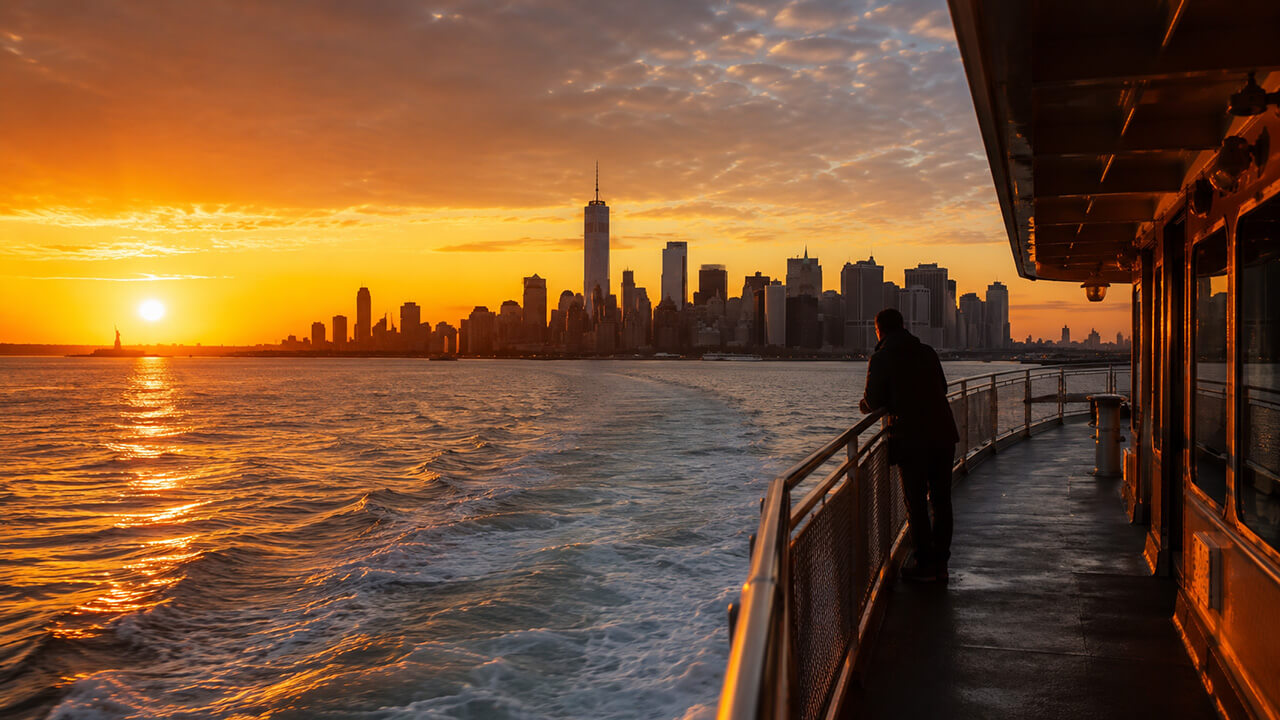
Every evening, as the city begins to dim and office towers glow against the fading sky, a quieter rhythm emerges along the waterfront. The crowds thin, conversations soften, and the final ferry of the day prepares to leave the dock.
For some, it’s simply transportation home.
For others, it has become a ritual.
The City Between Day and Night
There is something different about the last ferry. Unlike the rushed energy of the morning commute, the evening crossing carries a slower mood. People lean against railings instead of staring at their phones. Backpacks rest at tired feet. The skyline reflects across darkening water while the wind carries away the noise of the streets.
The city feels suspended between two worlds — no longer fully working, not yet asleep.
As the ferry pulls away from the terminal, passengers instinctively turn toward the horizon. Sunset spreads across the river in layers of orange, pink, and deep blue, transforming even the most familiar skyline into something cinematic.
For a brief moment, everyone stops rushing.
A Daily Escape on the Water
Commuters often speak about routines with exhaustion, but ferry riders understand something different. The crossing itself becomes a pause button between work and home.
The gentle movement of the boat, the sound of water against the hull, and the open air create a rare sense of separation from the city’s intensity. It’s one of the few commutes where people willingly slow down to watch the journey unfold.
Some passengers read quietly. Others wear headphones and stare into the distance. A few stand outside regardless of the cold, unwilling to miss the final light disappearing behind the skyline.
The ferry becomes more than transit — it becomes transition.
Sunset as a Shared Experience
One of the most remarkable things about the last ferry is how strangers briefly share the same moment without speaking.
A businessman loosens his tie while watching the sky change color. A student photographs the skyline through the glass. Couples sit silently beside each other as the city lights begin to flicker alive.
Nobody announces it, but everyone notices the sunset.
In a city built on speed and schedules, the ferry creates an unexpected collective stillness.
The Beauty of Repetition
What makes this ritual meaningful is its repetition. The route rarely changes. The skyline remains familiar. The docks, the river, the hum of the engines — all predictable.
Yet every evening feels slightly different.
Clouds shift. Seasons change. Winter sunsets disappear quickly while summer evenings linger across the water. Some days the river is calm like glass; other nights it moves with restless waves and wind.
The commute stays the same, but the experience never truly repeats itself.
A Reminder to Slow Down
Modern life often pushes people to optimize every minute. Faster routes, shorter waits, constant notifications. But the last ferry resists that pace.
Out on the water, there is nowhere else to be for those few minutes.
No traffic to fight.
No shortcuts to take.
No reason to hurry.
Only the skyline, the fading light, and the steady movement home.
Why the Last Ferry Matters
To outsiders, it may look ordinary — just another commuter boat crossing the river at sunset. But for the people onboard, it quietly becomes part of daily life’s emotional landscape.
A boundary between stress and rest.
Between work and personal time.
Between daylight and night.
The last ferry is not simply about reaching a destination. It is about reclaiming a small moment of peace in the middle of urban life.
And sometimes, that small ritual becomes the most meaningful part of the day.