
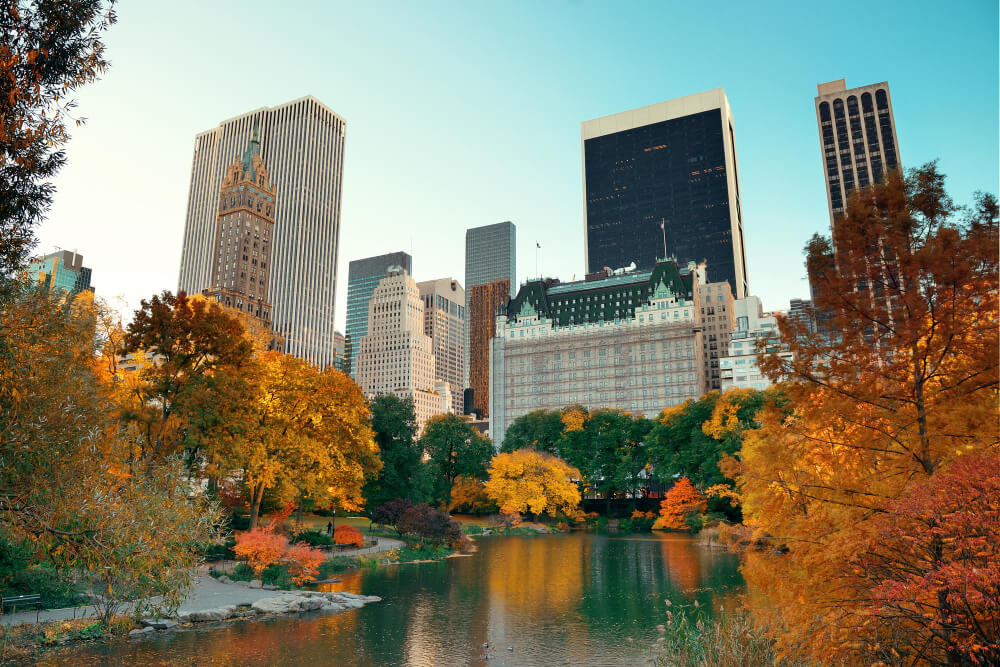
Late October brings a short, reliable window when New York’s concrete edges soften. The facades along the East River catch amber light differently, and the waterfront tree lines shift from green to deep crimson. For photographers who want to capture NYC autumn skyline photography that goes beyond the standard postcard angle, the work starts with location. Specifically, the islands and greenway edges where fall foliage wraps directly around the skyline.
The strongest compositions come from juxtaposing Manhattan’s hard geometry against the organic texture of changing leaves. That contrast tells a seasonal story no summer shot can replicate.
Finding the Right Vantage Points for Autumn Skyline Photography New York
Most tourists gravitate to the interior paths of The High Line or the central loop of Central Park. Both are worth visiting, but neither offers the unobstructed river framing that makes autumn skyline photos work. The real vantage points sit on the water’s edge, where you have depth, reflection, and foreground foliage in the same frame.
FDR Four Freedoms State Park (Roosevelt Island)
FDR Four Freedoms State Park pairs restrained granite architecture with rows of copper beech trees that shift to deep amber each fall. At the southern tip of Roosevelt Island, you’re shooting across a narrow East River channel with the United Nations complex as your mid-ground and Midtown Manhattan rising behind it. It’s a layered composition most NYC fall foliage spots simply can’t offer.
- Location: Roosevelt Island, New York, NY 10044. Positioned at the absolute southern tip of Roosevelt Island, directly across the East River channel from the United Nations Headquarters and south of the landmark Smallpox Hospital Ruins.
- Access: Open Wednesday through Monday from 9:00 AM to 7:00 PM (Closed Tuesdays).
- Transit: Take the iconic Roosevelt Island Tramway from 59th Street/2nd Avenue or ride the F/M subway train directly to the Roosevelt Island station.
Spot-Specific Camera Settings & Angles
- The Best Angle: Position your tripod at the very tip of the granite “V” at the southern end of the park. Instead of shooting straight across the river, angle your camera slightly north-west to capture the leading lines of the copper beech trees pointing directly toward the United Nations building.
- Ideal Gear & Settings: Use a wide-angle lens (16-35mm) to emphasize the sweeping architectural lines of the park. Set your aperture to a narrow f/11 or f/16 to ensure both the golden tree canopy in the foreground and the Manhattan skyline in the background are razor-sharp. Keep your ISO at 100 for maximum dynamic range.
Pier 1 at Brooklyn Bridge Park (DUMBO / Brooklyn Heights)
Brooklyn Bridge Park converted Pier 1 from a working shipping dock into a waterfront meadow with dense plantings of sumac and sweetgum trees. In fall, those trees produce some of the most saturated reds and purples in the borough, framing the Brooklyn Bridge’s stone towers directly.
- Location: 1 Water Street (at the intersection of Old Fulton Street and Water Street), Brooklyn, NY 11201. Sits directly adjacent to the historic Fulton Ferry Landing and is flanked immediately by the 1 Hotel Brooklyn Bridge.
- Access: Open daily to the public from 6:00 AM to 1:00 AM. Maintained via the Brooklyn Bridge Park Corporation.
- Transit: Subway A/C trains to High Street-Brooklyn Bridge Station, 2/3 trains to Clark Street, or the NYC Ferry directly to the DUMBO landing.
Spot-Specific Camera Settings & Angles
- The Best Angle: Avoid the crowded promenade edge. Instead, step back onto the winding woodland paths just behind the Granite Prospect viewing steps. Look for gaps in the red and purple sweetgum leaves and use them as a “natural vignette” to frame the stone towers of the Brooklyn Bridge.
- Ideal Gear & Settings: Switch to a standard or short telephoto lens (50mm to 85mm) to compress the background. Open your aperture slightly to f/4 or f/5.6 and focus directly on the bridge’s architecture. This will create a soft, cinematic blur (bokeh) on the vibrant fall leaves framing the shot, making the skyline pop out of the organic borders.
Mastering Your Seasonal Skyline Photos Manhattan Settings
Capturing the subtle interplay between autumn leaves and reflective glass requires precise manual adjustments. The intense glare of the low autumn sun can easily wash out your colors if you aren’t careful.
While spot-specific settings are detailed above, your baseline setup should always include a circular polarizer filter. This is non-negotiable for river photography; it cuts down the harsh water glare and dramatically deepens the sky’s blue tones, allowing the orange and red foliage to heavily contrast against the background.
If the evening turns chilly, transitioning your photo walk into a romantic evening is easy when using a curated waterfront date night guide or taking a quiet break on the elevated Pier 57 lawn to watch the final rays of sun hit the harbor.
Local Behavior Insight: The Fleeting Golden Canvas
True New Yorkers know that the best NYC fall foliage spots aren’t static locations found on generic tourist apps. They are discovered by embracing the neighborhood’s natural pacing. We look for the way the morning light filters through the maples tucked away between the best piers in Manhattan.
We monitor the wind patterns managed by NYC Parks to know exactly when a storm might clear the canopy. The true reward comes from wandering without a rigid schedule, letting your lens be guided by the unpredictable, brilliant dance of autumn colors wrapping around the city’s concrete heart.
The Copper Twilight: A City Framed in Gold
When the sun dips below the New Jersey horizon, the autumn foliage loses its bright punch and takes on a deep, brooding silhouette. The windows of Manhattan ignite with gold reflections, and for a few minutes, the boundaries between nature and architecture completely blur. It is a sensory reminder of why we stay in this city.
To keep discovering these hidden, seasonal perspectives along the water’s edge join our community of local explorers and let’s document the city together.
FAQs
The northern pathways of Pier 1 at Brooklyn Bridge Park and the southern tip of Roosevelt Island offer the absolute best vantage points for framing the Manhattan skyline through a natural border of autumn leaves.
Peak foliage along the NYC waterfront typically occurs between late October and early November, running slightly later than upstate regions due to the urban heat island effect keeping coastal temperatures milder.