
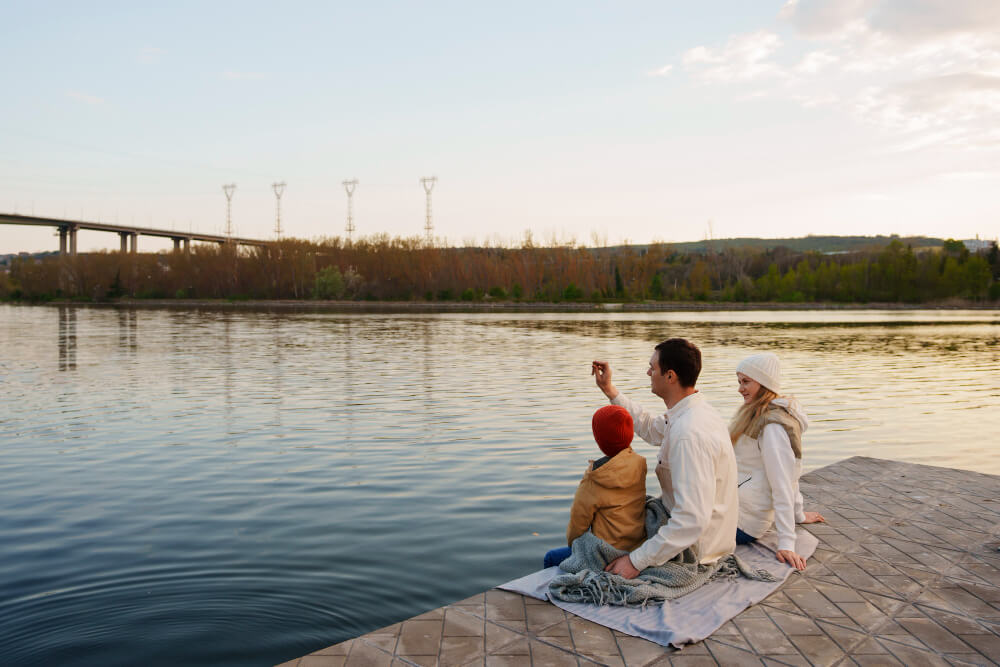
Standard travel guides funnel families toward the neon noise of Times Square or the security lines of high-rise observation decks. But New York’s real rhythm unfolds where the concrete gives way to open riverfront space and the kind of salt-cooled air that slows everyone down, including the kids.
This guide covers a full family day along the New York waterfront, from a hands-on ecology walk in Tribeca in the morning through a lawns-and-ferries afternoon in Chelsea.
Why the Waterfront Beats Midtown for a Family Day Out
A few honest comparisons are worth making before you plan. A visit to a midtown observation deck costs upward of $40 per adult. A harbor cruise runs $35 to $55 per person. The piers listed in this guide are almost entirely free, and they offer something the paid attractions cannot: room to move, room to rest, and a view that changes with the tide.
The waterfront also scales well across age groups. A toddler who needs open grass to run across and a grandparent who wants a bench with a harbor view can share the same pier comfortably. That is the quiet, practical advantage the Hudson River and East River shorelines have over any indoor attraction in the city.
Morning: Tribeca Piers
The early morning on the Lower West Side riverfront belongs to local families. The light off the downtown towers is sharp, the breezes are cooler, and the piers have not yet filled with foot traffic from other neighborhoods. Start here.
9:30 AM: Hands-on Ecology at Pier 26
Pier 26 operates as a working ecological environment rather than a passive park. Children can walk along elevated wooden walkways through native switchgrasses, observe the custom tide deck where brackish East River water rises and falls to reveal local blue crabs, and take part in guided naturalist sessions run on-site by the Hudson River Park Trust.
This is one of the few places in Manhattan where a school-age child can crouch beside an actual tidal habitat and spot a crab in its natural environment without a ticket or a museum barrier between them and the water. The pier anchors the southernmost section of Hudson River Park, with One World Trade Center visible to the south and the historic Tribeca skyline to the east.
- Location: Pier 26, Hudson River Park, Tribeca
- Access: Free daily entry; guided naturalist tours available on select dates
- Best for: Ages 4 and up; toddlers enjoy the wide walkways and water views
- Transit: 1 train to Canal St, then walk west to the river
11:00 AM: Energy Burn at Pier 25
A short walk south along the Hudson River Greenway brings you to Pier 25, which functions as the neighborhood’s most active outdoor play space. The pier has a full maritime-themed playground with climbing structures, plastic slides, and a dedicated sandpit area. An 18-hole mini-golf course runs along the waterside edge for families with older children who need a structured activity after the open-ended ecology walk.
The playground entry is free. Mini-golf has a small per-round fee. The pier’s design keeps the play area and the viewing areas clearly separated, which means younger children can move freely while parents watch from benches with an unobstructed view of the river.
- Location: Pier 25, Hudson River Park, Tribeca
- Access: Free playground; mini-golf fees apply
- Best for: All ages; the playground is suitable for toddlers through age 10
- Transit: 1 train to Franklin St, then walk west
- Nearby: Historic Harrison Street corridor and vintage vessels permanently docked at the adjacent marina
Afternoon: Chelsea Piers
After a morning of active play, the afternoon calls for a slower pace. Moving up the Hudson River Greenway into Chelsea brings you to two of the most visually distinctive public spaces on the entire waterfront.
1:30 PM: Storybook Exploration at Little Island
Little Island sits on a cluster of tulip-shaped concrete columns just off the Chelsea waterfront, and it genuinely looks like it arrived from somewhere else. The elevated park opened in 2021 and is maintained by a private conservancy. Children are drawn immediately to the musical chimes embedded in the pathways, the gentle inclines that double as natural viewing platforms, and the open amphitheater where live performances run through spring and summer.
The park’s design prioritizes open movement over structured programming, which makes it particularly well-suited for younger children who need to explore freely. The views from the upper paths across the Hudson toward New Jersey are clear and uninterrupted. The elevated walkways also offer an unusual perspective on the large shipping vessels passing through the lower harbor.
- Location: Little Island, Pier 55, Chelsea
- Official site: littleisland.org
- Access: Free daily entry, 6 AM to 11 PM; some ticketed performances
- Best for: All ages; the gentle terrain is stroller-accessible throughout
- Transit: A, C, E, or L trains to 14th St, then walk west to the Hudson River
- Nearby: The elevated rail of The High Line and the Whitney Museum of American Art
3:30 PM | Rooftop Respite at Pier 57
Two blocks south of Little Island, Pier 57 houses a two-acre public roof garden accessible by elevator from street level. The lawn is one of the most underused open spaces on the Manhattan waterfront, precisely because its entrance is not obvious from the street. Once you are on the roof, the space opens into a wide, flat grass area with completely unobstructed views of the lower harbor, the Statue of Liberty on clear days, and the arc of New Jersey’s shoreline.
- Location: Pier 57, Chelsea
- Access: Free roof park access daily via central elevators
- Best for: All ages; fully flat and stroller-accessible
- Transit: A, C, or E trains to 14th St, then walk west
- Nearby: Chelsea Market food hall, one block east; the historic metal archway of old Pier 54
A good wind-down before the evening crowd arrives for the sunset spots Manhattan couples favor later in the evening.
Seasonal Guide: When to Visit Each Pier
The waterfront experience changes significantly across the year. Knowing when to visit each location prevents disappointment, particularly for families traveling from outside the city.
- Spring (March to May): The most reliably comfortable season. The piers are uncrowded, the light is clear, and Pier 26’s ecological programming restarts in April when the tidal wildlife becomes active again. Little Island opens its full spring schedule of free performances in late April.
- Summer (June to August): Peak season for Governors Island, Little Island amphitheater programming, and NYC Ferry ridership. Arrive at the piers before 11 AM to secure space on the lawns. Pier 57’s rooftop is particularly good in the evening when the harbor breeze cools the space.
- Autumn (September to November): The best season for Pier 57’s rooftop and Brooklyn Bridge Park. Cooler temperatures, exceptional light, and dramatically reduced tourist density make October the strongest single month for a family waterfront day in New York.
- Winter (December to February): Governors Island closes seasonally. The Hudson River Park piers remain open year-round. Pier 26’s ecology deck is quieter, but the tidal habitat is still visible. Pier 25’s playground stays open in clear weather. The harbor views from Pier 57’s rooftop in cold, clear winter air are among the sharpest in any season.
Practical Tips for Families
A few logistics that make the difference between a smooth waterfront day and a difficult one:
- Strollers: All piers in this guide have flat, paved surfaces and elevator or ramp access to elevated decks. The Hudson River Greenway connecting Pier 25 and Pier 26 is fully stroller-accessible. Little Island’s paths are stroller-friendly throughout.
- Restrooms: Clean public restrooms are located at Pier 25, Pier 26, Little Island, and Pier 57. Governors Island has public restrooms at multiple points across the island.
- Food: Pack snacks for the morning pier; Tribeca has limited waterfront food vendors. The afternoon Chelsea section has significantly more options, with Chelsea Market immediately adjacent to Pier 57.
- NYC Ferry: The public ferry connects several piers in this guide and costs the same as a subway fare. We recommend checking the NYC Ferry app for real-time departure times before committing to a crossing, particularly on summer weekends when boats fill quickly.
- Timing: Arrive at Hudson River Park piers before 10 AM on summer weekends. The afternoon Chelsea section is best visited between 2 PM and 5 PM when the morning crowds at Little Island have thinned.
For more information about waterfront activities in New York, join our community of pier and skyline enthusiasts by signing up for our weekly newsletter.
FAQs
Yes. Pier 26, Pier 25, Little Island, and Pier 57 all have wide, flat boardwalks, smooth paved pathways, and ramp or elevator access to elevated decks. Clean public restrooms are at each location.
Pier 26 in Tribeca and Pier 57 in Chelsea. Both are built around native landscapes and open lawns rather than commercial retail. Pier 57’s rooftop in particular sees a fraction of the foot traffic of the more photographed Hudson River Park locations.
Where the Horizon Resets
When the light drops behind the Jersey hills and the river goes dark, the piers empty out and become something else entirely. Worth coming back for.
If you’re planning an evening out, the waterfront proposals NYC guide has the best spots to extend the day.