
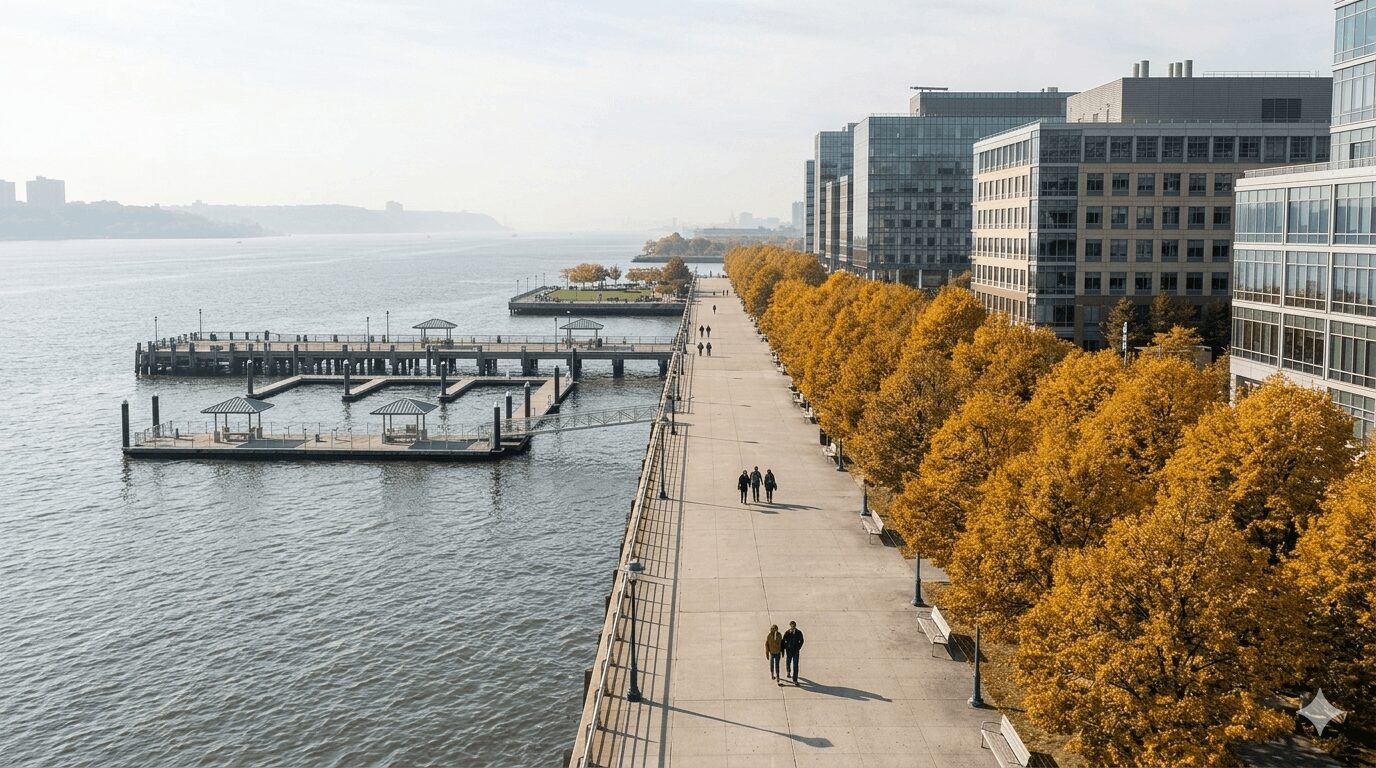
The shift happens overnight. One morning you walk outside and the thick summer humidity is simply gone. In its place is a sharp breeze carrying dried leaves and cold asphalt. Tourists head straight to Central Park or up to the New York Botanical Garden when they want autumn colors. Locals know the most striking contrast of the season happens right at the island’s edge. Bright yellow leaves against deep blue water is a combination that the parks cannot replicate. Finding the best piers in Manhattan for fall foliage during October and November is an essential autumn ritual.
Immersive Foliage at NYC Waterfront Spots
The west side of Manhattan is heavily planted with diverse foliage that turns gold, crimson, and burnt orange through the season. The waterfront provides an expansive open foreground for sweeping autumn shots. The juxtaposition of delicate, dying leaves against permanent city steel is visually extraordinary.
Because the waterfront is exposed to colder river winds than the inland parks, foliage along the Hudson and East Rivers tends to turn slightly later than Central Park. Here is an approximate peak window for each featured location:
| Location | Tree Species | Peak Window | Best Time of Day | Crowd Level |
| Pier 45 (West Village) | Mature maple, oak | Late Oct to early Nov | Afternoon (golden hour) | Low-Medium |
| Pier I, Riverside Park South | Oak, railway-adjacent growth | Late Oct to mid-Nov | Early morning (river mist) | Low |
| Pier 64 (Chelsea) | Wild grasses, mixed deciduous | Mid to late October | Morning or late afternoon | Low |
| The Battery Esplanade | Ancient ginkgo trees | Late Oct to early Nov | Morning (harbor light) | Low-Medium |
Pier 45 in the West Village
Walking into Hudson River Park during peak autumn is a deeply sensory experience. Pier 45 is uniquely suited for leaf viewing because it features massive, mature shade trees right on the wooden deck. As the leaves turn, they create a glowing golden canopy over the grass. You can sit directly under the falling leaves while watching the boats pass, which makes it one of the most immersive autumn environments on the entire waterfront.
- Location: Hudson River Park at Christopher St
- Camera Setting: Wide aperture like f/2.8 to focus on a single falling leaf while softly blurring the New Jersey skyline
- Access: Open public pier with sprawling lawns and paved perimeters
- Transit: 1 Train to Christopher St
Pier I at Riverside Park South
Further uptown, the paths managed by the Riverside Park Conservancy offer some of the most heavily wooded stretches of the waterfront. Pier I extends long into the river, surrounded by old railway gantries and towering oak trees that turn a rich rust color in late autumn. It is one of the most reliable NYC waterfront spots for dramatic autumn light filtering through the branches, especially during the early morning when river mist still hangs over the water.
- Location: Hudson River near W 70th St
- Camera Setting: ISO 200, shutter speed 1/60s to capture the silhouetted skyline through a bright autumn canopy
- Access: Ramped access down to the water level pier
- Transit: 1/2/3 to 72nd St
Whenever a quiet stretch of waterfront lines up just right with the autumn light, it goes into the Pier to Skyline newsletter. Worth reading for seasonal finds like this one.
Skyline Photography and Hudson River Piers
Depth is everything in seasonal skyline photography. Whether you are using professional gear from B&H Photo Video or just a smartphone, the layered approach works: colorful foreground leaves against the dark river surface, with towering skyscrapers rising behind. This is the visual structure that makes pier experiences Manhattan photographers return to each autumn.
Pier 64 in Chelsea
Jutting out into the Hudson, Pier 64 is lined with wild grasses and trees that frame the water beautifully in autumn. Looking south, the bright foliage creates a natural frame around a clean shot of the downtown skyline. The contrast between organic reds and oranges and the glass buildings of the Financial District is sharp and satisfying.
- Location: Hudson River Park at W 24th St
- Camera Setting: f/11 for a sharp landscape shot that keeps both the foreground leaves and the distant skyline crisp
- Access: Open to the public, wide paved paths
- Transit: C/E Train to 23rd St
The Battery Esplanade
At the southern tip of Manhattan, The Battery features ancient trees that turn a brilliant, uniform golden yellow in late October. Standing at the waterfront railings here lets you frame vibrant foliage against the cold, gray harbor. Local culture guides like Time Out New York frequently highlight downtown foliage, but standing at the water’s edge gives you angles that no inland path can offer.
The Battery: Ginkgo Detail and Post-Shoot Warm-Up
The ancient ginkgo trees at The Battery are among the most reliable fall foliage subjects in Lower Manhattan. Ginkgo leaves turn a vivid, uniform yellow before dropping almost simultaneously, creating a carpet of gold along the promenade paths. The window is brief, often just a few days in late October or early November. Check local foliage reports in the week before your visit. Afterward, Stone Street, two blocks north, has several warm, low-lit bars and restaurants that make an ideal endpoint for a cold morning at the water’s edge.
- Location: State Street and Battery Place
- Camera Setting: Standard 50mm lens to naturally compress bright yellow trees against the distant Statue of Liberty
- Access: Open public park pathways
- Transit: 1 Train to South Ferry or 4/5 to Bowling Green
Local Behavior Insight: Chasing the Crisp Light
Local photographers do not shoot midday in the fall. The real local approach is braving the early morning chill. We arrive at the waterfront just as the sun breaks over Queens, knowing the autumn mist on the river will act as a natural diffuser. We keep gear light and move constantly, walking handheld through the side streets of the West Village until we find where the golden hour light cuts perfectly through the turning leaves.
The Frame Where Water Meets the Autumn
Fall photography in New York is not just about the leaves. It is about the mood. The air feels urgent, knowing winter is close. By positioning yourself at the best piers in Manhattan, you are not just photographing a skyline or a tree. You are capturing the exact moment the city exhales before going quiet for the season.
To map out your walking route, see our full breakdown of The Best Piers in Manhattan.
FAQs
Because the waterfront is exposed to colder river winds, trees along the water tend to turn slightly later than those inland. Late October through the second week of November is typically the best window.
Significantly less crowded than Central Park. The Hudson River paths offer miles of paved walkways, making it easy to find a quiet spot even on peak autumn weekends.